How to Write an MICU Progress Note

Table of Contents
  1. Brief Synopsis
    a. Common mistakes
  2. 24-Hour Course
  3. Objective
    a. Vitals
    b. Intake/Output
    c. Physical Exam
    d. Electrolytes
    e. Relevant Imaging
  4. Assessment and Plan
  5. Checklist Manifesto

Brief Synopsis 

Whether or not this is a necessary thing to do, I always start my MICU progress notes with a summary of the events that have occurred since hospitalization. I will update this section when significant events occurred. 

Example: This is a 46-yo F with a history of type 1 diabetes who is on day 1 of hospitalization and presented with nausea and vomiting. On presentation, the patient was found to have an anion-gap metabolic acidosis with ketonuria and was admitted to the MICU for management of diabetic ketoacidosis with insulin gtt, and frequent lab draws. Since admission, her anion gap has closed and was bridged with subcutaneous insulin. 

I think if a resident can summarize the chief complaint and what we are treating, then ICU becomes a heck of a lot easier. When you struggle on your ICU rotation, remember to ask yourself, “what are we treating” and “why is this person sick?”

Common mistakes

  • Copying and pasting incorrect information
  • Not updating important events that took place
  • Listing out every possible past medical history that is not relevant to the case and fluffing the sentences

24-Hour Course

In this section, I like to add everything that has happened over the last 24 hours. I write out my 24-hour events the same way every single time. 

  • Subjective: What the patient said, what the nurse said, any events overnight)
  • Vitals: Are they hemodynamically stable? If not, how is their hemodynamics managed?
    • Example: Patient remains afebrile over 24 hours, requiring Levophed 15 mcg and vasopressin for hemodynamic support. 
  • Intake and Output: This is especially important for ICU patients as they are critically ill and, more times than not, if ignored, can easily become under or over-resuscitated. Please obtain accurate intake and output every single day. 
  • Labs: I do not list out values; I state what those values mean. 
    • Example 1: Instead of writing Na+ 121 with an osmolarity of 230, I will write hyperosmolar hyponatremia.Example 2: If the values are significant, like renal functioning, and we are trending the values, sometimes I will write out relevant information only. Side note: You will lose your attending if you just rattle off and list a bunch of lab values. This can be done in the lab section if you wish to reiterate the significant lab findings. 
The program I use is EPIC. This is more or less how a template will appear. The *** means you cannot sign your note unless you address that section.

Objective

Vitals

Record vitals over 24 hours. Ensure you indicate episodes of tachyarrhythmias or bradyarrhythmia. Not the times when vitals change. Consider why those values are changing (i.e., is the patient agitated, is the patient in pain, do they have a lead wire that accidentally activates the SA node?) 

Intake/Output

In brief, I want to reiterate the importance of fluid balance in the ICU. Once again, one needs to ask themselves, “where is the fluid going.” If you notice that your patient is +15 L and cannot be weaned from the ventilator, chances are there is a problem, which is wet lungs, for example. 

Physical Exam

You can still do a complete physical examination on an ICU patient. For example, if a patient is sedated and intubated, a neurological exam can still be performed. Please check the pupillary, corneal, gag, respiratory, and other reflexes every morning. This is essential in patients who have been ventilated for more than a few days.  

Electrolytes

I want to briefly touch on the importance of electrolyte balance in critically ill patients, especially when uncommunicative.

  • Sodium: Ensure the patient is receiving enough water to prevent hypernatremia (more on this topic later)
  • Potassium: Values should stay above 4 mmol/L to 4.5 mmol/LMagnesium: Values should be >2 mEq/L
  • Phosphorous: Looking at these values is especially true in our patient population, where the majority are from a nursing home fed through PEG tubes. Thus, one must be aware of refeeding syndrome and should ensure phosphorous levels are adequate. 

Relevant Imaging

List out any relevant imaging that will help round out the case. A common mistake I hear is when someone reads aloud an impression from a radiologist without first trying to make their own impression regarding the imaging. You are not expected to be a radiologist, but at least make the effort to look at the images.  
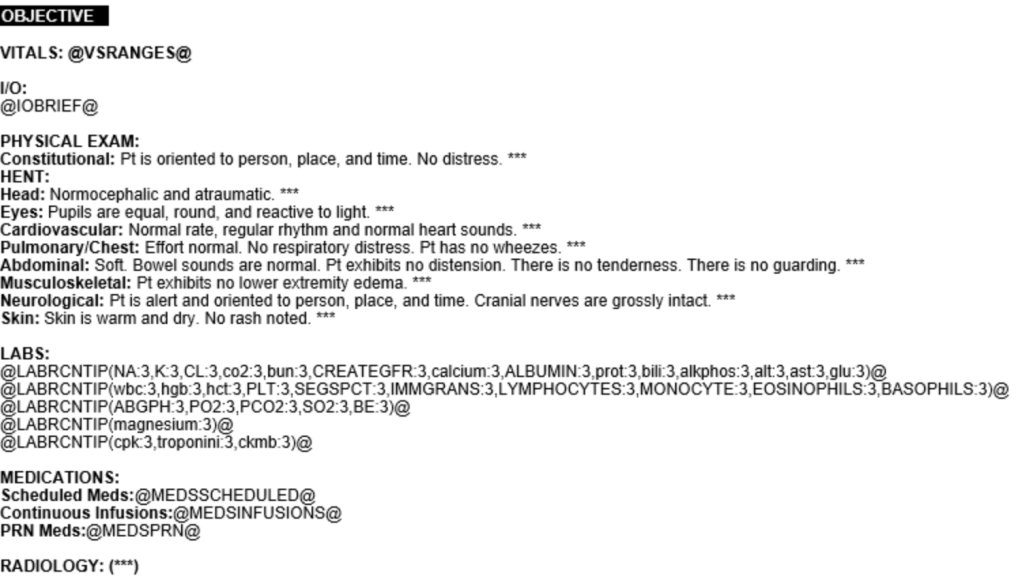
Demonstrating the use of coding to auto-populate notes so the provider can save time on documentation.

Assessment and Plan

Very different than a typical ward patient hospitalist patient. If you have ever been on pediatric rotation, it is similar in that ICU patients are assessed by systems. Why? Because patients in the ICU have multiple systems involved and must be addressed so that nothing gets overlooked. Get in the habit of writing your notes the same way every day. This will allow your brain to think in an organized fashion. Below is a sample of the template that I follow. 

Neuro:
#Diagnosis*
Assessment

  • Plan


Example
Neuro:
#Hepatic encephalopathy
His wife reported he was sleeping more often during the day before the presentation. He is AAO x 1, appears disoriented, and has asterixis. 

  • Insert NG tube for medication administration
  • Ordered lactulose 30 mL tid via NG tube to titrate to a total of 3 bowel movements per day

Below I listed out a sample of the template that I use to help me to remember to add details where it is needed while modifying it to look like the above. 


Neurology:

  • Current RASS: ***, RASS goal: ***
  • Brain stem reflexes: ***
  • Sedative requirements: ***
  • Pain management: ***

Cardiology:

  • Cardiac rhythm: ***
  • HR/BP: ***
  • Vasopressor requirements: ***
  • MAP goal >65 mmHg

Pulmonary:

  • Option 1: Patient denies SOB, lungs are clear to auscultation, no acute findings of CXR. 
  • Option 2: Date Intubated: ***; Patient is on mechanical ventilation with mode setting ***, ABG: *** 
  • MAP goal >65 mmHg

Gastroenterology:

  • Option 1: Patient is on *** diet 
  • Option 2: Tube feeds via *** with *** at *** cc/h. 

Nephrology/Electrolytes:

  • Intake: ***/Output: ***/Net: ***
  • K+: ***
  • Mg2+: *** 

Infectious Disease:

  • Abx: *** day ***/***

Endocrinology:

  • TSH: ***, Hga1c ***% on ***
  • Insulin regimen: ***
  • BG goal <180 mg/dL

Hematology:

  • ***

Checklist Manifesto

THE CHECKLIST IS ESSENTIAL! Please do NOT copy and paste this section. Copying and pasting notes are okay to a certain extent but be reminded if you copy and paste material that is not up to date, this can be detrimental to a patient’s care. In addition, if your note is used in court, you may be deemed unreliable as an author if the notes do not reflect your care. 

How to Write a History and Physical

  1. Chief Complaint (CC)
  2. History of Present Illness (HPI)
  3. Past History
    1. Medical History
    2. Surgical History
    3. Medications
    4. Allergies
    5. Family History
    6. Social History
    7. Review of Systems (ROS)
  4. Objective
  5. Assessment and Plan

A history and physical, or H+P for short, is a document that will paint how a patient presents to the hospital. If a patient is a re-admit to the hospital, a physician can look at previous H+Ps to determine if a patient’s presentation was like their current presentation. With electronic medical records on the rise, many hospitals can share notes with other institutions without faxing documents. Why is this important? This means your documentation reflects you and the institution you are working for. In addition, it is helpful when a physician appropriately documents because it can help prevent duplicate work-ups, bettering patient care, and save healthcare dollars. 


Chief Complaint (CC)

A big mistake I see interns make is not acknowledging the chief complaint. We are here to help the patient: If the physician works up an entirely different problem unrelated to the chief complaint that the patient initially presented with, then that physician has not done their job correctly. Always listen to the patient because this will provide you with most of your information to crack down on your diagnosis. 

History of Present Illness (HPI)

The HPI is where the physician will document the details of the patient’s chief complaint. In school, I was taught the mnemonic OLD CARS; please see below. 

  • O – Onset
  • L – Location
  • D – Duration
  • C – Characterization
  • A – Aggravating factors
  • R – Relieving factors
  • S – Symptoms

This mnemonic is excellent when you do not know where to start. You can collect enough information, and it will be organized and detailed. That said, when a patient speaks to you, going in an exact order sometimes is not feasible. But do not despair, this is normal, and patients are not robots. Additionally, most patients do not understand that physicians collect information in a specific way, so you may find that you must redirect your questions. 

Side note: I struggled with the above-stated concept because of my Type A personality. I did not realize that real life differs from the books and what you learned. Eventually, you will find your groove, but it does take time. Do not be frustrated.

Past History

Medical History

Sometimes patients will tell you that they do not have a medical history, only for a physician to find out that the patient is taking multiple medications. 

One way I phrase this question is “what type of medical problems do you have, for example, hypertension, diabetes, high cholesterol, etc.” Sometimes this helps prompt the patient to understand what data you are trying to extract from them.

Surgical History

It is important to be direct and observant when asking about a patient’s surgical history. Sometimes the patient forgets about surgeries because they might have occurred over two decades ago. 

Side note: I once had a patient who claimed that he had no surgeries and come to find out he had a large linear scar on his anterior chest wall, and he forgot that he had a sternotomy with an aortic and mitral valve replacement.

You want to find out what surgery it was when it was, and if there were any complications. Example

Example: Right inguinal hernia repair – 2012 – no complications

Medications

With medications, you want to ask the following, 

  • Name of medication
  • Dosage
  • Frequency
  • Reason
  • Sometimes ask who the prescriber is

Side note: I think it is important to know where a patient is obtaining their prescriptions from. Sometimes you will find that the patient is getting the prescription from a friend or family member. This can be dangerous for the patient and is an opportunity to educate the patient on the importance of following up with a healthcare provider. 

Allergies

Ask the patient if they have any known allergies or drug allergies. If the patient states yes, please ask them to specify their reaction. A lot of times a patient might state they are allergic to a medication, but they are experiencing an adverse side effect of the medication.  

Examples:

  • Penicillin – Anaphylactic shock (This is a true allergy)
  • Morphine – “upsets my stomach” (This is not an allergy)

Family History

This is especially important in primary care as many guidelines are based on diseases within 1st-degree relatives. This information is also useful for risk stratification, which can determine if someone is admitted to the hospital. 

Social History

The mnemonic FEDTACOS is helpful when trying to recall relevant social history. 

  • F – Food
  • E – Exercise
  • D – Drugs
  • T – Tobacco (cigarettes, cigars, vaping, etc.)
  • A – Alcohol
  • C – Caffeine intake
  • O – Occupation
  • S – Sexual history

Sometimes asking these questions may not feel relevant, but when piecing all the items together, a physician can paint a story of why and how a patient requires hospitalization. 

Review of Systems (ROS)

This section is really for “anything else.” I like to add many of these questions to my HPI if they are relevant. When a physician becomes more experienced, they can obtain a focused ROS. 

Side note: When obtaining the history from the patient, one can decide to ask the history questions in reverse order (social history, family history, allergies, medications, surgical history, and medical history). As I mentioned previously, many patients will not be able to recall their past medical history unless prompted by their medication list. 

Objective

This section is self-explanatory. This is the section that is data-driven based. There should be no statements, opinions, or assessments in this section. 

  • Vitals
    •  Vitals are the ones you recorded in the presentation. 
  • Physical Exam
    • This section should be complete, accurate, and honest in examining the patient.  
  • Labs
  • Imaging

Assessment and Plan

Please see my post on “How to Write a Progress Note” to effectively execute this section. Aside from the HPI, the assessment and plan are among the most critical areas to master in the documentation.  

How to Write a Progress Note

Table of Contents

  1. Components of a Progress Note
  2. Subjective
    a. Common mistakes
  3. Objective
    a. Common mistakes
  4. Assessment
    a. What is your assessment?
  5. Plan

Components of a Progress Note 

As an internal medicine resident, you must develop the skill of documenting appropriately and effectively. A progress note is a legal document to communicate your patient care and involvement. You never know who will stumble upon your documentation, so you must write a good note. 

  • Subjective
  • Objective
    • Vitals
    • Physical exam
  • Assessment
  • Plan

Subjective

A subjective should only contain subjective data. This includes the patient’s own words and nursing communication. This can also include overnight events. Please see the example below. 

Example 1: “Patient states he is feeling better, and he is no longer experiencing chest pain. He denies further episodes of palpitations, dyspnea, nausea, or vomiting.” 

This is an example of a patient communicating in their own words.

Example 2: “Per nursing staff, the patient had an episode of emesis described as non-bloody and non-bilious. Zofran was administered x 1, and emesis episodes resolved.” 

This is an example of a nursing communication

Example 3: No acute events overnight. The patient denies any acute complaints. 

This is an example of concisely stating that there were no acute events. 

Common mistakes

  • Writing your impression or assessment. 
  • Writing vital signs. 
  • Stating no events occurred when the patient was given multiple PRNs during the night.
  • Copying and pasting previous notes and not changing pertinent information. 

Objective

If you use Epic or another EMR system, this area will likely be auto-populated. Your objective area should look something like the following: 

  • Vitals
  • Physical exam 
  • Labs
  • Imaging

Common mistakes

  • Stating a person is well appearing when they are frail, malnourished, or in acute distress.
  • Copying and pasting previous physical examinations. 
  • Writing physical exams that you did not perform.

    Remember, any note you write is a legal document. If your notes are chosen to be reviewed in a court, for example, they may be deemed unreliable if it is noted that the documenter is not appropriately documenting. 

Assessment 

This is the hardest part to master. It will take time, but one needs to be organized so a reader can easily follow your thought process. An assessment is when you commit to a diagnosis. A diagnosis does not have to necessarily be right, but at least you have a direction you follow. You will also discuss relevant differential diagnoses. As an intern, you must go through this exercise to become a well-developed physician and not pigeonhole yourself to one diagnosis.

Example: Let’s say a 58-year-old man with uncontrolled hypertension and type 2 diabetes presents to the emergency department with a complaint of left-sided chest pain that radiates to the shoulder, is relieved at rest, and is associated with nausea and vomiting. In the ED, a work-up reveals elevated troponin and ST depressions in multiple leads. 

What is your assessment?

#Chest pain 

Or 

#Acute coronary syndrome, NSTEMI 

Some common mistake expected as an intern is not being specific enough regarding a diagnosis. It is not wrong to state chest pain, but it also does not provide a lot of information or a working diagnosis. There are many reasons for chest pain and many ways it can be treated. Therefore, specificity is essential. 

Taking it a step further, we need to discuss our thought process and think of 2 to 3 differentials that merit writing out. 

Example: 

#Acute coronary syndrome, NSTEMI
Mr. Yoon is a 58-yo male with multiple risk factors for acute coronary artery disease, which include uncontrolled hypertension, type 2 diabetes, obesity, and tobacco abuse. He does not follow with a primary regularly. He presents with typical chest pain relieved with rest in the setting of troponinemia and ECG changes most consistent with an NSTEMI and will need further ischemic workup. If work-up is negative, other differentials should be considered, including GERD, costochondritis, or anxiety, though all unlikely given his significant lab and ECG findings.  

This addresses why the author believes that the patient has an NSTEMI. The author then includes other differentials but makes it apparent that these differentials are very low on the list. This case is straightforward, but some patients will not present in such a forward manner. Thus, it is important to commit to a diagnosis, explain your thought process, and give other potential differentials.  

Finally, being able to integrate problems as one instead of separating each one out demonstrates the mastery of medicine. For example, a young doctor may separate out chest pain, nausea/vomiting, and elevated troponins. However, we can see that they are all related, given his likely diagnosis. Whenever you have a patient with multiple problems, challenge yourself to see how each problem may be related. 

Plan

Once you have your assessment, you must come up with your plan. It is important to be specific and direct. Taking our chest pain example, we should see the following: 

#Acute coronary syndrome, NSTEMI – GRACE Score 77 points, TIMI Score 4 points
Mr. Yoon is a 58-yo male with multiple risk factors for acute coronary artery disease, which include uncontrolled hypertension, type 2 diabetes, obesity, and tobacco abuse. He does not follow with a primary regularly. He presents with typical chest pain relieved with rest in the setting of troponinemia and ECG changes most consistent with an NSTEMI and will need further ischemic workup. If work-up is negative, other differentials should be considered, including GERD, costochondritis, or anxiety, though all unlikely given his significant lab and ECG findings.  

  • Load with ASA 325 mg and c/w ASA 81 mg daily
  • Load with clopidogrel 600 mg and c/w clopidogrel 75 mg daily
  • Ordered atorvastatin 80 mg daily 
  • Ordered troponin q3h until peak with ECGs
  • Ordered 2D echocardiogram to assess for wall motion abnormality
  • Will consult cardiology for invasive vs non-invasive ischemic workup

If the writer has done an excellent job explaining their assessment, it is likely the plan will not need further explanation. However, if it is unclear why a lab or other imaging is ordered, a writer should provide further explanation. 

Please keep in mind that every attending has a style that they choose to write in. However, I found this method to be the most organized and effective way to relay my thought process. Thank you so much for reading my post, and do not hesitate to reach out for more advice.

xoxo, Dr. M.